


Who were the Onas or Selknam?
In the southernmost reaches of the planet, in the Great Island of Tierra del Fuego, this nomadic hunter indigenous people lived. They were related to the Tehuelches or Patagonians who inhabited north of the Strait of Magellan, though with distinct traditions. Their religion was polytheistic and they believed in something similar to a heaven and hell after death.

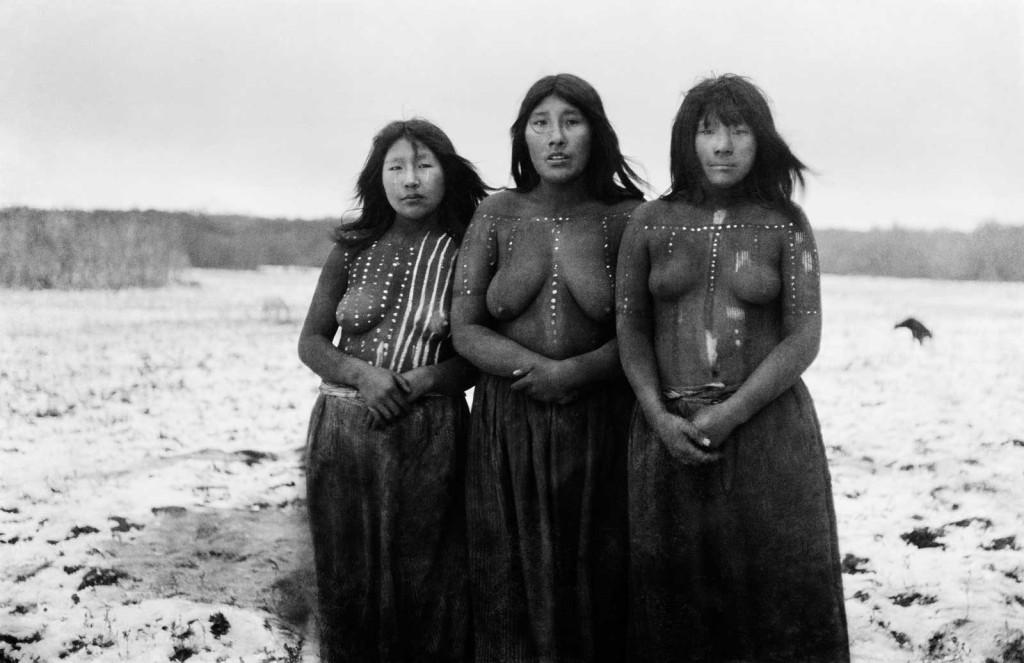
Physically, the men stood out because, unlike most Amerindians, they were very tall and heavily built. Both sexes had exceptional resistance to the extreme cold of those latitudes. It's enough to see that in most photographs they are naked or semi-naked, partially covered with guanaco skins, their main prey and source of subsistence. In fact, as protection against the cold, the Onas would cover their bodies with guanaco fat, something that helped them maintain body heat.

This people's relationship and the origin of the name "Tierra del Fuego"
In 1520, Magellan crossed the channel that would bear his name. Although his crew had no direct contact with the Onas, in the lands south of the channel they saw a great number of columns of smoke, undoubtedly caused by bonfires. Ona women had the responsibility of keeping the fire alive at all times to warm themselves and receive the men returning from their hunts. This custom led, in the eyes of the first Europeans, to the name "Tierra del Fuego".
The h'ain or the Ona initiation ritual

For the Onas there was no transition stage between childhood and adulthood. An initiatory rite (reserved only for men) certified maturity, through the revelation of tribal secrets. The shaman was in charge of leading this entire ritual, in addition to imposing a series of harsh tests of morality, courage and physical resistance on the children who had to stop being children. This rite was performed in one of their constructions away from the camp, to protect the entire ceremony from the curious eyes of women.
The myth behind the h'ain
The era of female domination:
The Onas firmly believed in a mythology that told how, in immemorial times, women held power and kept men subjugated. And they did it in a very ingenious way: they told the men that there existed an underworld monster called Xalpen, that demanded hunting meat or the men would start to be devoured. The women, led by Kreeh, were the only ones who could act as intermediaries with that evil beast and other spirits. To make the men believe this story, many females, wearing masks and painting their bodies, made appearances spreading terror among the subjugated men, who had to hunt, gather food and care for children, while the women pretended to appease evil spirits.
The discovery of the lie:
A man, husband of Kreeh, discovered the deception upon hearing women mock the gullibility of men. He gathered all the hunters of the tribe and they raided the women's hut, killing them all. Only Kreeh managed to escape and, in that endless chase with her husband at her heels, Kreeh became the moon (bruised from the fight that took place) and her husband (Kreen) became the sun. Both were condemned to chase each other eternally.
The reversal of roles The men, wounded in their pride, decided to adopt the deception and establish a new order over the girls, the only survivors of the massacre who had not yet been initiated into the h'ain. A new era of power was opening.

The paintings and masks of the h'ain
According to the myth, the men had the duty to represent the spirits in order to maintain their supremacy and a favorable order. This explains the secrecy and male exclusivity of this ritual.

The masks, made of wood and/or guanaco leather, were repeated in each h'ain. Each one of them represented a spirit that had its own personality and differential role. The "actor" had to have an attitude and movements in keeping with the spirit he had to represent.

The ceremonial paintings had symbolic value and were made with clays. Men and women who did not represent any spirit also painted their bodies and faces in a more discreet way, although they were not allowed to wear masks.
The brutal extermination of the Onas
In 1905, just 20 years after white man colonized Tierra del Fuego, the Onas had been almost completely annihilated. This completely premeditated genocide was driven by the owners of the new livestock ranches that developed on the island. José Menéndez, a powerful businessman, promoted the so-called "hunts of Indians" in which he paid for each person murdered, whether man, woman or child. Argentine and Chilean authorities did nothing to prevent it. In fact, to this day, one of the main streets in Punta Arenas bears the name "José Menéndez".

Learn more about the Ona people and culture with this video:
If you like to travel and discover new places and peoples, our social networks will interest you.
What did you think of Ona culture and rituals? You can comment below for our entire community.


Be the first to comment
Your comment opens the conversation